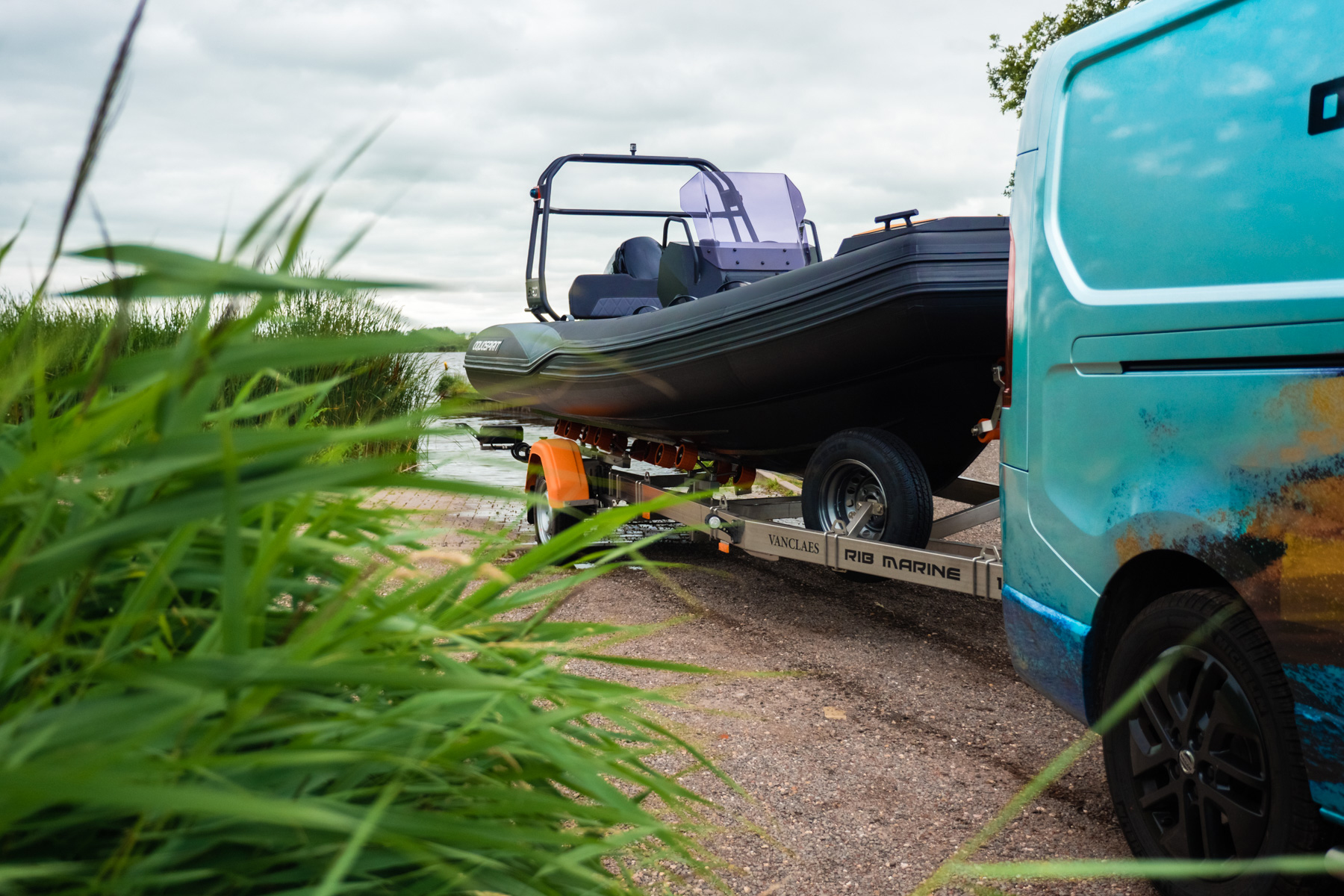
Even a small inflatable travels on a trailer. Most owners never have to think about which one, because the boat, the engine and the trailer come from the dealer as a matched package. The question only arrives later, when the trailer needs replacing and the nearest supplier is not a marine specialist and cannot tell you whether what they have will fit.
Start with the boat's own user manual. It gives you the hull dimensions and the weight the trailer has to carry, which rules out most of the catalogue before you begin. What follows is what to look at among the ones that are left.
Contact area is the whole specification
A trailer carries the rigid hull, and the more of that hull it touches, the better the load spreads. More rollers, or bigger bolsters, means less pressure at every individual point. Skimp on it and the boat's full weight goes through a handful of contact patches, over every pothole between the slipway and home.
Bolsters before rollers
Where you get the choice, take bolsters. A roller touches the hull along a narrow band; a bolster supports a broad strip of it. Rollers make launch and recovery easier, which is why they are common, but the contact area is obviously smaller.
Whichever you end up with, they should follow the shape of the hull rather than sit under it at an angle, and the keel line is the best place for them to bear: on most rigid hulls that is the strongest part of the structure.
What heavy-duty should mean on the spec sheet
Heavy-duty springs, larger wheels, and galvanizing that is rated for marine use rather than general outdoor use. The galvanizing matters more than it sounds like it should. The trailer is the one part of the whole outfit that gets reversed into salt water and then parked wet.
Loading it without leaving marks
- Inflate the tubes properly first. A soft boat does not settle onto the supports where it is meant to, and you cannot judge its shape.
- Haul the boat on using the bow eye, not a strap looped around whatever is convenient.
- Lower the engine shaft and fix it to the support provided on the trailer.
- Leave the self-bailer open so water drains out instead of collecting on the way home.
- Strap the boat down tight, using the bow and rear towing eyes.
- For a long trip, put the overall cover on. Dust and stones off the road abrade tubes and hull at motorway speed.
One thing that makes all of this easier: a welded aluminum hull is usually lighter than the fiberglass equivalent of the same size, so the trailer, the springs and the car doing the towing all get a smaller job. That comparison is set out in full in aluminum vs fiberglass hulls.